Best Crypto Accounting Tools Comparison (2026 Benchmark)

By Iraklis Anastasiou · September 21, 2026 · Updated September 21, 2026
The regulation of the cryptocurrency ecosystem has crossed an irreversible threshold. Corporate treasuries holding Bitcoin, as well as other blockchain-denominated digital tokens, DeFi protocols managing decentralized balance sheets, and traditional financial institutions entering Web3 can no longer rely on manual spreadsheets or generic accounting software. The catalyst is a synchronized, transatlantic legislative overhaul that has transformed crypto bookkeeping from an operational afterthought into a strict legal mandate.
The CLARITY Act would have settled US market structure by splitting oversight between the SEC for securities and the CFTC for digital commodities, but the Senate cloture vote failed in September 2026. The evidentiary burden has not gone away with it. US broker-dealers, spot exchanges, and token issuers still have to deploy high-fidelity subledgers capable of proving exact asset provenance, real-time cost basis, and segregated customer custody to federal examiners.
What did become law is narrower. The GENIUS Act (Guiding and Establishing National Innovation for U.S. Stablecoins Act) now imposes rigorous 1:1 reserve backing, mandatory public disclosures, and routine audit requirements on payment stablecoin issuers. The broader market structure bill stalled, so while targeted guardrails like the GENIUS Act manage stablecoin reserves, the US digital asset market remains without a durable statutory framework. Without legislative safe harbors, American crypto businesses must brace for continued "regulation by enforcement" from federal agencies.
Across the Atlantic, the European Union is tightening the vise on institutional data integrity. Beyond the baseline requirements of the Markets in Crypto-Assets (MiCA) directive, financial entities handling digital assets are now bound by the digital operational resilience act (DORA). DORA mandates severe IT risk management, third-party software vetting, and data continuity controls, meaning the software a firm uses to track on-chain assets must meet bank-grade security standards. Furthermore, as tokenized traditional assets proliferate, compliance with MiFID II requires meticulous best-execution reporting, trade transparency, and client fund segregation that legacy systems simply cannot compute.
To navigate these overlapping, multi-jurisdictional compliance minefields, alongside global tax mandates like the OECD's CARF and the EU's DAC8, financial officers require robust software platforms and professional auditing services. The mandate is clear: translate high-volume, fragmented on-chain transactions into audit-ready financial statements compliant with US GAAP and IFRS.
This benchmark report compares the leading digital asset accounting engines, subledgers, general ledgers, and audit solutions available to enterprise finance teams operating in this new regulatory reality.
Architectural & Functional Comparison Matrix
How we compiled this, and our interest in it. Figures were taken from each vendor's own published material in September 2026. Where a vendor publishes pricing we link to that page; where pricing is quote-based, the range shown is indicative, drawn from third-party reporting rather than the vendor, and should be treated as a starting point rather than a quote. Certifications are as claimed by each vendor. Ondology Labs appears in this comparison as an audit provider rather than a software vendor, so read our own row with that interest in mind, and verify current figures with each vendor before you decide.
| Platform | Core Focus & Positioning | Supported Chains / Sources | General Ledger / ERP Sync | Regulatory & Audit Credentials | Primary Price Point |
|---|---|---|---|---|---|
| Bitwave | Enterprise Subledger & B2B Payments | 80+ Blockchains | NetSuite (SDN Partner), QuickBooks, Sage Intacct, Xero, Oracle Cloud, MS Dynamics | SOC 1 Type 2, SOC 2 Type 2; Deloitte & RSM Alliances | Quote-based, indicatively $80K–$500K+/year |
| Cryptio | Regulated Institutional Subledger | 150+ Blockchains & Custodians | Native ERP Sync (NetSuite, SAP, Xero, custom exports) | SOC 1 & SOC 2 Type 1 & 2 (PwC Audited) | Quote-based, indicatively $60K–$400K/year |
| Tres Finance | Multi-Chain Institutional Reconciliation | 220+ Networks & Banks | General ERP Sync & custom financial exports | SOC 1 & SOC 2 Data Quality Standards | Quote-based enterprise |
| Lukka | Institutional Data Infrastructure | 100+ Chains, 500+ Exchange Sources | NetSuite, SAP, financial data pipelines | SOC 1 & SOC 2; SAB 122 & MiCA aligned | Quote-based enterprise |
| Breezing | SMB & Accounting Firm Subledger | 58 Blockchains, 17 Exchanges | Direct sync with Xero, QuickBooks Online, Bexio | SOC 2 Type II; Swiss Made Software | $29–$2,917/month, published |
| SoftLedger | Full Native General Ledger (GL) | GL-focused (API ingest for crypto add-on) | Native GL (replaces external accounting software) | SOC 1 Type II | $13,500/year base, published |
| Ledgible | Tax Professionals & Regulatory Reporting | Multi-chain (SOC-certified platform) | NetSuite, Xero, QuickBooks, UltraTax CS, GoSystem | SOC 1 & SOC 2 Type 2; CARF & DAC8 engine | $49–$199+/yr (Indiv) to Enterprise |
| Cryptoworth | High-Fidelity Subledger for DAOs & DeFi | 1,000+ Integrations claimed | NetSuite, Sage Intacct, QuickBooks | SOC-certified security claimed | Quote-based enterprise |
| Ondology Labs | Independent Audit & DAC8/MiCA Services | Major chains (On-demand forensic data ingest) | Non-software model (Outputs ISA working papers & reports) | ICPAC-Licensed Statutory Partner; ISA 500/620 compliant | Engagement-based pricing |
Enterprise Subledgers & Multi-Chain Reconciliation
Bitwave: Deep Enterprise & ERP Integration
Bitwave is built for US-headquartered enterprises, publicly traded entities, and middle-market corporations with complex ERP requirements. As an official Oracle NetSuite SuiteCloud Developer Network (SDN) partner, it offers native, automated synchronization with enterprise general ledgers. Bitwave excels in handling intricate smart contract interactions, indexing over 50,000 DeFi protocols, and providing B2B stablecoin invoicing via integrations such as the Canton Network.
- Strengths: Dual SOC 1 Type 2 and SOC 2 Type 2 certifications, strategic alliance with Deloitte, and advanced stablecoin payment rails.
- Considerations: Highest entry barrier, with annual subscriptions typically ranging between $80,000 and $500,000 plus implementation fees.
Cryptio: Audit-Grade Institutional Compliance
Cryptio focuses on regulated financial institutions, digital asset funds, and crypto-native enterprises requiring high data integrity. Utilizing node-based indexing directly from raw blockchain data, Cryptio mitigates the risk of third-party API discrepancies. Its internal controls were audited by PwC, making its subledger data readily acceptable to Big Four auditors.
- Strengths: SOC 1 and SOC 2 Type 2 audited by PwC, multi-inventory virtual segregation, and robust coverage across 150+ blockchains and custodians.
- Considerations: Less extensive automated DeFi workflows compared to Bitwave.
Tres Finance: Network Breadth & Automated Reconciliation
Tres Finance stands out for its coverage across 220+ Web3 networks, centralized exchanges, and banking sources. Designed to solve multi-chain accounting fragmentation, Tres implements a triple-verified reconciliation engine to match wallet balances against General Ledger entries automatically.
- Strengths: Unmatched chain breadth, strong audit trail documentation, and asset management portfolio reporting.
- Considerations: Enterprise pricing requires sales consultation.
Specialized Infrastructure, General Ledgers, and Tax Solutions
Lukka: Institutional Valuation & Data Infrastructure
Lukka transitioned its focus to providing enterprise-grade financial data infrastructure. Processing over 10 billion daily trading ticks across 27 price-discovery exchanges, Lukka acts as an institutional reference-data layer for valuation, automated variance reconciliation, and regulatory compliance (including SEC SAB 122 and MiCA).
- Strengths: Unrivaled institutional pricing engine and pre-configured regulatory report templates.
- Considerations: Operates as a data infrastructure layer rather than a full turnkey accounting subledger.
SoftLedger: The Full General Ledger Solution
Unlike subledger solutions that sit between the blockchain and an external accounting system (like QuickBooks or NetSuite), SoftLedger is the general ledger. It features real-time multi-entity consolidation, intercompany elimination entries, and a multi-dimensional general ledger where digital assets are tracked directly inside the core accounting system.
- Strengths: Eliminates the need to maintain separate accounting software; includes multi-entity consolidation out-of-the-box.
- Considerations: Requires migrating the entire financial stack to SoftLedger.
Breezing: Modern SMB & Mid-Market Subledger
Breezing targets small-to-midsize businesses, Web3 startups, and accounting agencies using Xero, QuickBooks Online, or Bexio. It publishes full pricing tiers, from $29 per month to $2,917 per month, with unlimited wallet connections and user seats across all tiers. Only Breezing and SoftLedger publish figures at all; every other platform here is quote-based.
- Strengths: Transparent pricing, SOC 2 Type II certified, Swiss data protection standards, and direct invoice/bill matching without dummy clearing accounts.
- Considerations: Focused on 58 core blockchains; not designed for heavy NetSuite/SAP enterprise deployments.
Ledgible: Regulatory Tax Engine (CARF & DAC8)
Ledgible bridges crypto activity with professional tax software systems, including Thomson Reuters UltraTax CS and GoSystem Tax RS. Its categorization engine natively handles Form 1099-DA compliance in the United States alongside global CARF and European DAC8 reporting standards.
- Strengths: Specialized tax compliance engine for CPAs, tax practitioners, and enterprise compliance desks.
- Considerations: Primary focus is tax compliance and regulatory reporting rather than deep operational inventory management.
Cryptoworth: DeFi Subledger Precision
Cryptoworth targets DAOs, Web3 projects, and high-frequency DeFi funds needing granular cost-basis calculation across decentralized liquidity pools, staking contracts, and cross-chain bridges.
- Strengths: High-fidelity inventory tracking across claims of over 1,000 integrations.
- Considerations: Requires specialized setup for non-standard DeFi contracts.
Professional services versus software
A key structural distinction in digital asset accounting is the division between continuous software subledgers (Bitwave, Cryptio, Tres, etc.) and independent audit/attestation services.
Ondology Labs operates as a specialized audit and compliance advisory firm headquartered in Cyprus. Rather than acting as a continuous SaaS subledger, Ondology Labs provides point-in-time independent financial statement audit support, Proof of Reserves attestations, DAC8 tax reporting packs, and MiCA regulatory evidence for European CASPs.
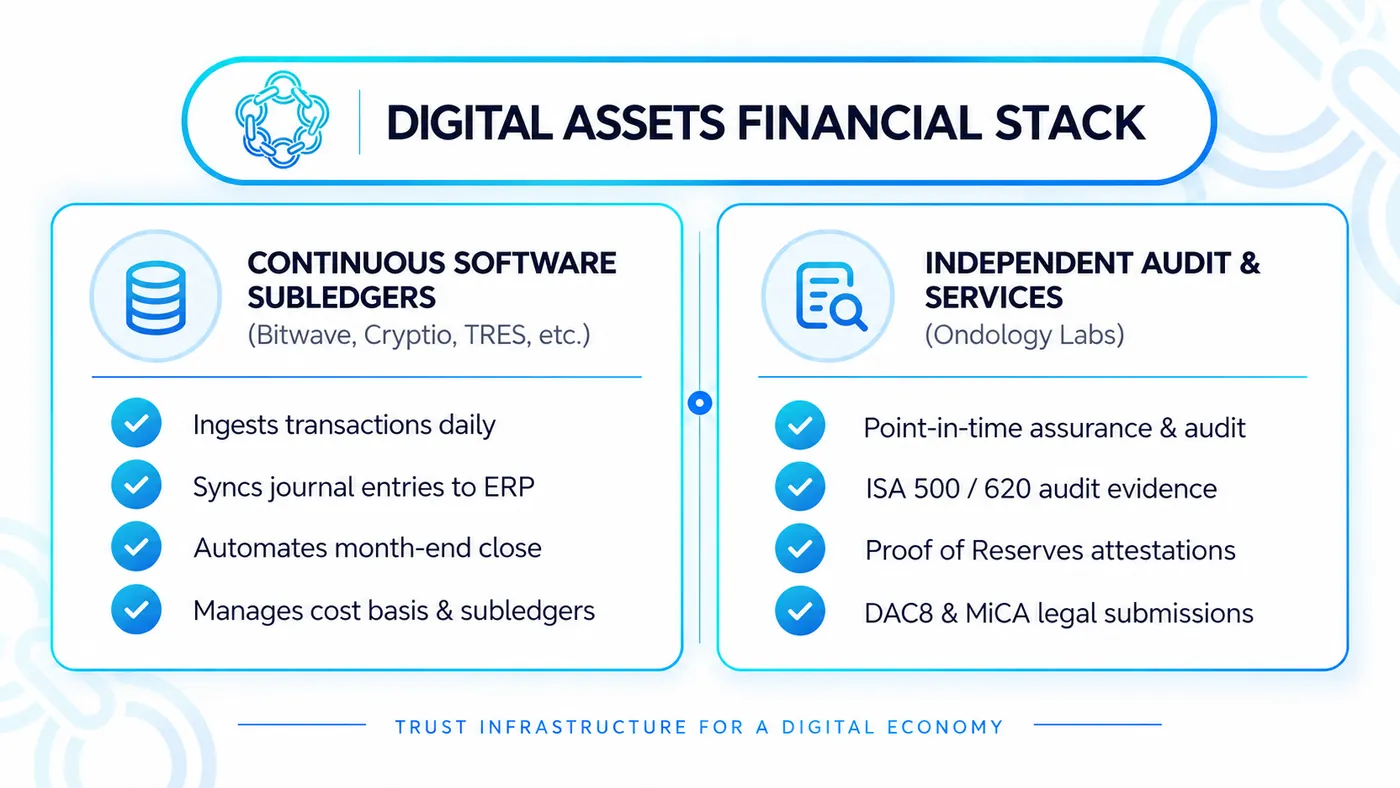
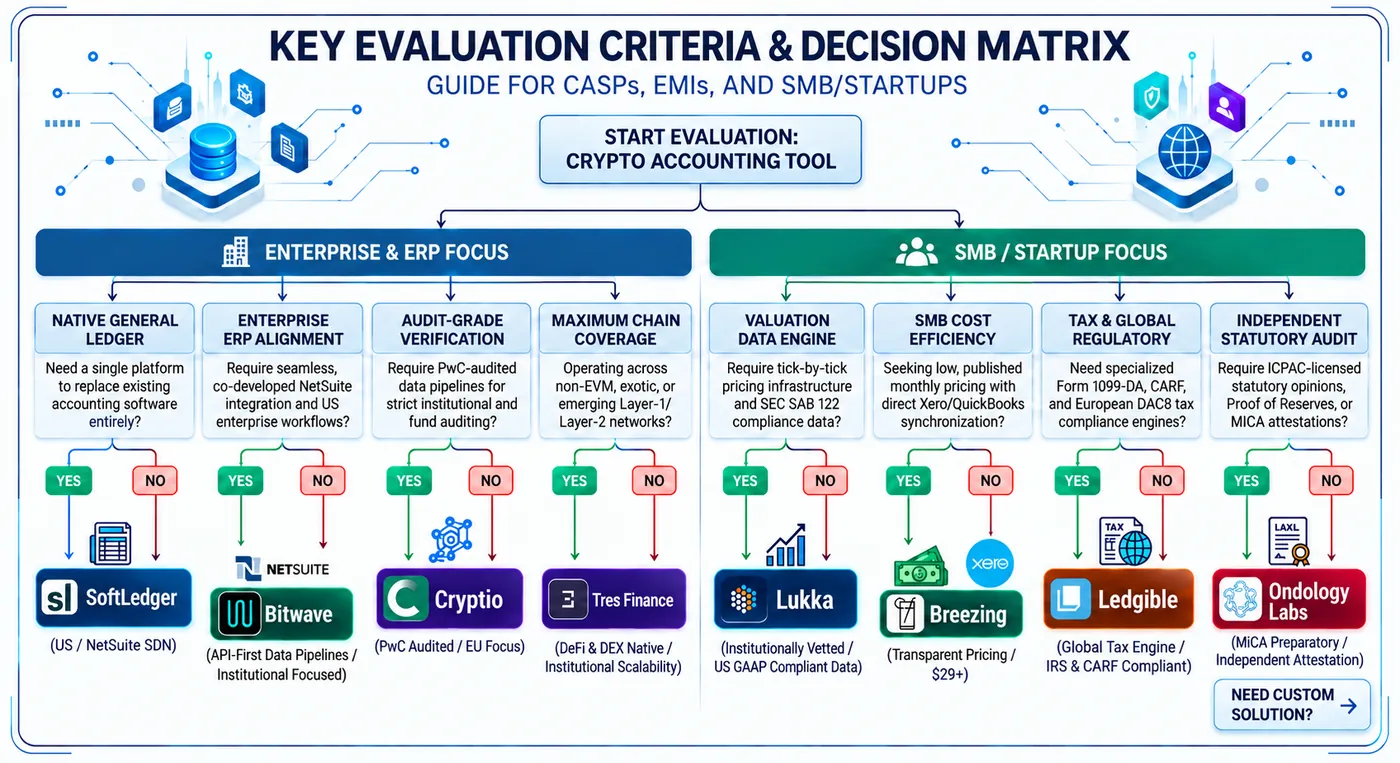
By working directly from public chain data and cryptographic key signatures, Ondology Labs generates audit working papers designed for reliance under International Standards on Auditing (ISA 500 and ISA 620) and issues statutory audit opinions via its ICPAC-licensed partner firm. For many regulated entities, the ideal operational posture involves deploying a SaaS subledger like Bitwave or Cryptio for daily bookkeeping, while engaging a firm like Ondology Labs for year-end statutory audits, Proof of Reserves verification, and regulatory filings. The decision path below applies to any CASP, EMI or institution holding crypto assets, whatever its operating jurisdiction.
Strategic Evaluation Matrix
| Decision Metric | Primary Driver | Benchmark Winner / Best Fit |
|---|---|---|
| Native General Ledger | Need a single platform to replace existing accounting software entirely. | SoftLedger Tres Finance |
| Enterprise ERP Alignment | Require seamless, co-developed NetSuite integration and US enterprise workflows. | Bitwave Cryptoworth |
| Audit-Grade Verification | Require PwC-audited data pipelines for strict institutional and fund auditing. | Cryptio |
| Maximum Chain Coverage | Operating across non-EVM, exotic, or emerging Layer-1/Layer-2 networks. | Tres Finance Cryptoworth |
| Valuation Data Engine | Require tick-by-tick pricing infrastructure and SEC SAB 122 compliance data. | Lukka |
| SMB Cost Efficiency | Seeking low, published monthly pricing with direct Xero/QuickBooks synchronization. | Breezing SoftLedger |
| Tax & Global Regulatory | Need specialized Form 1099-DA, CARF, and European DAC8 tax compliance engines. | Ledgible |
| Independent Statutory Audit | Require ICPAC-licensed statutory opinions, Proof of Reserves, DAC8 integrations, or MiCA attestations. | Ondology Labs |
Selecting the appropriate digital asset accounting architecture depends on three factors: entity size, existing ERP infrastructure, and jurisdictional regulatory exposure.
- For US Enterprises & NetSuite Users: Bitwave remains the premier choice due to its direct SuiteCloud Developer Network integration, robust controls, and B2B stablecoin features.
- For Global Regulated Institutions & Funds: Cryptio and Tres Finance provide superior node-level data validation and multi-chain reconciliation tailored for institutional audit scrutiny.
- For Mid-Market & Web3 SMBs: Breezing delivers an unmatched value proposition with transparent pricing, zero user-seat caps, and simple Xero/QuickBooks integration.
- For Statutory Compliance & Audits: Software tools handle day-to-day transaction flows, but firms subject to Europe's MiCA directive or global DAC8 mandates should pair their subledger with specialized auditing firms like Ondology Labs to ensure cryptographic proof of reserves and audit-ready working papers.
The era of managing corporate digital asset holdings through unverified spreadsheets or improvised software patches has given way to a supervised reporting framework. As legislative frameworks like the GENIUS Act and CLARITY Act in the United States, alongside MiCA, DORA, MiFID II, and DAC8 in the European Union, enforce strict institutional standards, software selection has become a strategic risk-management mandate.
For enterprise CFOs and controllers, the key to navigating this landscape lies in aligning organizational complexity with the right technology stack. High-volume corporations requiring deep Oracle NetSuite integration will find their benchmark in Bitwave. Regulated institutions prioritizing audit-grade chain index integrity will lean toward Cryptio or Tres Finance. Organizations replacing their core GL entirely can leverage SoftLedger, while growing SMBs on Xero or QuickBooks gain a clear, cost-effective path via Breezing.
Crucially, software platforms only provide half the equation. As statutory audits, Proof of Reserves, and regulatory filings draw unprecedented scrutiny from auditors and tax authorities, pairing continuous subledgers with specialized independent audit partners like Ondology Labs ensures that multi-chain data stands up under full regulatory examination. In 2026 and beyond, financial compliance is no longer just a cost center, it is the baseline for institutional credibility in Web3.
How Ondology Labs can help: A subledger produces the numbers, but somebody still has to attest to them. We deliver statutory crypto financial statement audits with CYAUSE Audit Services, our ICPAC-licensed audit partner, provide crypto audit support as the technical experts for audit firms and in-house finance teams, run proof of reserves engagements, prepare DAC8 reporting packs, and assemble MiCA readiness evidence for European CASPs. Where the subledger output and the chain disagree, transaction reconciliation is how we close the gap. This comparison is general information based on publicly available vendor material, not a recommendation or professional advice for any specific situation.
Related reading: Crypto audits in 2026: the new standard · How to read a proof of reserves report · Crypto reporting obligations in Cyprus. · What a crypto audit costs in Cyprus