DAC8 and CARF: A Crypto Tax Guide for International Expats Living in the EU

By Iraklis Anastasiou · July 15, 2026
International tax residents, including U.S., Indian, Emirati and Singaporean expats living in the EU, must navigate a web of global CARF data exchanges and strict tax residency rules that dissolve historical offshore crypto tax havens.
Part 3 of 3 · The 2026 Crypto Tax Transparency Series
Part 1: The GENIUS Act & U.S. tax · Part 2: The EU's DAC8 dragnet · Part 3: Crypto tax for expats in the EU
For international tax residents residing in the EU, the operational launch of DAC8 and its global integration with CARF eliminate the geographic and informational insulation that previously characterized cross-border digital asset holdings, through the free exchange of information between crypto service providers. Following the OECD's endorsement of CARF, the European Union pledged to adopt the rules beginning January 1, 2026, for all EU Member States, and they are now in effect.
Tax residency in international law is determined by physical presence, center of vital interests, and treaty tie-breaker rules, subjecting individuals who reside in an EU member state to unlimited tax liability on their worldwide income, regardless of the physical location of the exchange or wallet.
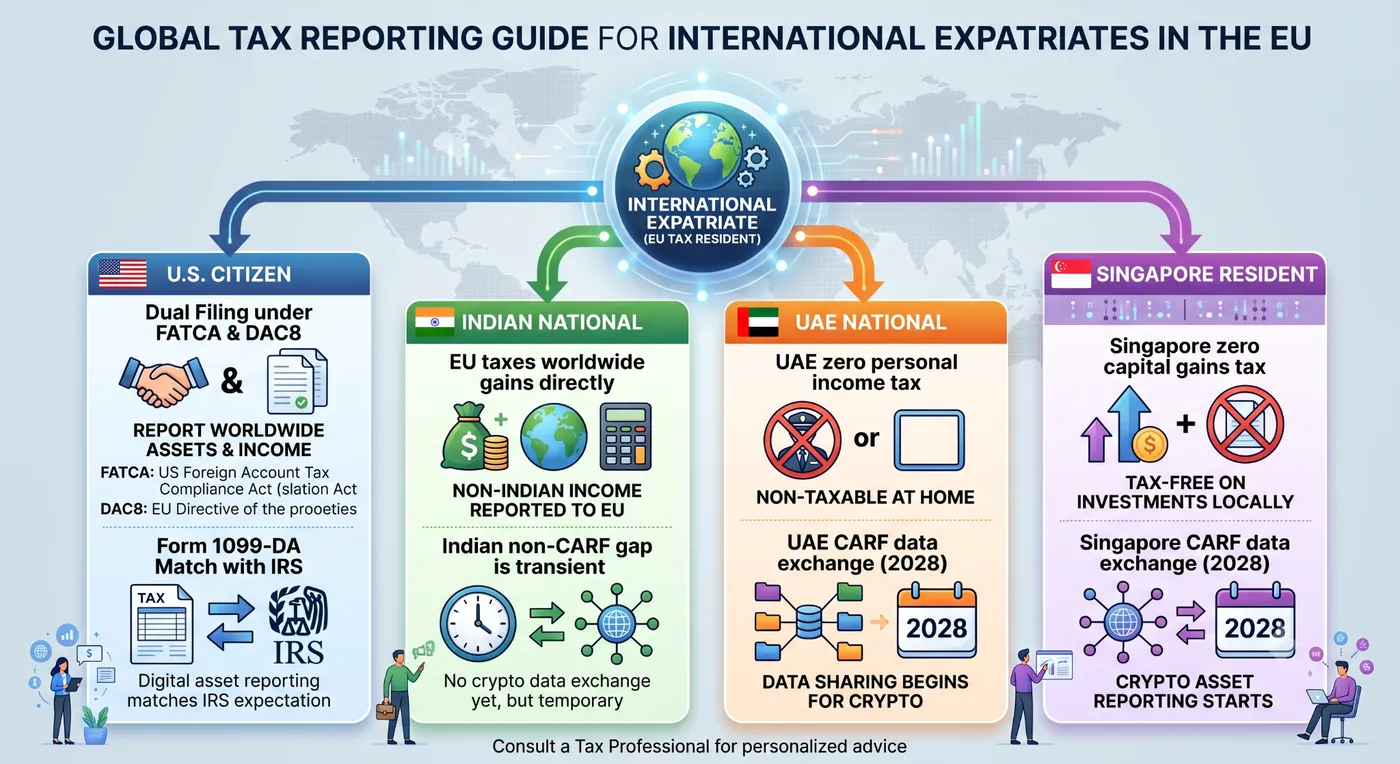
Figure 1: How global tax reporting applies to U.S., Indian, UAE and Singaporean expatriates who are EU tax residents
1. United States Citizens Residing in the EU
U.S. citizens living within the European Union are subject to a complex, dual-layered tax reporting structure. Because the United States enforces citizenship-based taxation, U.S. citizens must report and pay taxes on their worldwide income to the IRS regardless of their actual country of physical residence. When residing in an EU member state, they are simultaneously classified as local tax residents, subjecting their worldwide digital transactions to the unlimited fiscal jurisdiction of their host European nation.
From a compliance perspective, these individuals are monitored through two distinct regulatory frameworks. Any European or offshore exchange used by a U.S. citizen will collect their host EU nation's TIN and report all transactions to the local European tax authority under DAC8. Simultaneously, under FATCA, foreign financial institutions must identify and flag U.S. persons, automatically reporting their account details and balances to the IRS. If these individuals use U.S.-based digital asset brokers, their transactions will be reported to the IRS on Form 1099-DA.
To avoid double taxation, U.S. citizens must claim the Foreign Tax Credit (FTC) on Form 1116, offsetting their U.S. federal tax liability by the amount of tax paid to their host EU country. However, because of differences in tax timing, such as Germany exempting gains after one year while the U.S. continues to tax long-term capital gains at rates up to 20%, taxpayers can face significant cash-flow and reporting mismatches.
Additionally, a U.S. citizen who attempts to expatriate to resolve this dual-reporting burden may be classified as a "covered expatriate" if their net worth exceeds $2 million or their average annual net income tax liability exceeds statutory thresholds. This classification triggers the U.S. Exit Tax, which treats all worldwide holdings, including all cryptocurrency and stablecoin positions, as if they were sold at fair market value on the day before expatriation, realizing immediate capital gains taxes on all unrealized paper profits.
2. Indian Citizens Residing in the EU
Indian nationals who relocate to the EU and meet local physical residency requirements (such as Slovakia's 183-day presence rule or Estonia's rolling 12-month domestic test) must report and pay taxes on their global income, including all digital asset transactions, within their host EU country.
This creates a significant mismatch with the domestic tax rules of their home country. In India, digital assets are subject to a flat 30% tax rate with no option to offset losses, alongside a 1% Tax Deducted at Source (TDS) on domestic transactions. Since India is classified as a non-committed jurisdiction under the OECD's CARF, Indian domestic exchanges are not currently participating in the automatic exchange of data with EU member states, creating a temporary informational gap.
However, this gap is narrow and carries high compliance risks. As EU tax residents, Indian nationals are legally required to self-report all foreign assets and worldwide transactions. If an EU tax authority detects undeclared transactions on Indian platforms (during an audit or through blockchain analytics tracking transfers to an EU custodial exchange), the taxpayer faces severe non-disclosure penalties. Administrations such as the Spanish Hacienda can apply indirect audit methods, assessing tax based on the unexplained accretion of wealth, resulting in administrative surcharges of up to 150% and potential criminal prosecution.
3. United Arab Emirates Residents Residing in the EU
The United Arab Emirates has become a prominent hub for digital assets due to its highly favorable domestic tax policy, which features a 0% personal income and capital gains tax on individual investors. While corporations are subject to a 9% federal corporate tax on profits exceeding AED 375,000, entities operating in free zones like the Dubai International Financial Centre (DIFC) or Abu Dhabi Global Market (ADGM) can maintain a 0% corporate rate on qualifying activities, such as proprietary trading, by demonstrating physical substance.
However, if a UAE national or expatriate establishes physical residency in the EU, the UAE's tax-free status is nullified. The individual's worldwide transactions are immediately subject to the tax rates of their host EU country. Any assumption that transactions executed on UAE platforms will remain hidden is outdated. The UAE is a signatory to the CARF MCAA, with mandatory data collection commencing in 2027 and automatic cross-border exchanges with EU tax authorities starting in 2028.
Consequently, any digital asset activity conducted on UAE-regulated exchanges (such as those authorized by Dubai's Virtual Assets Regulatory Authority or Abu Dhabi's FSRA) by an EU tax resident will be automatically reported to their home EU tax authority by 2028. Failure to declare these transactions during 2026 and 2027 will lead to retrospective audits and significant non-compliance penalties once the CARF data exchange begins.
4. Singaporean and Asian Residents Residing in the EU
Singapore operates under a territorial tax framework and does not impose a general capital gains tax on personal investments. Gains from the disposal of digital payment tokens are tax-free for individual investors, provided the transactions are classified as private investment rather than an active trade or business. If the Inland Revenue Authority of Singapore (IRAS) determines that activity constitutes a business (evaluated using "badges of trade" such as holding periods, transaction frequency, and commercial intent), profits are taxed as ordinary income at progressive rates up to 24% for individuals, or a flat 17% corporate tax rate for companies.
For a Singaporean or Asian resident who relocates to the EU, Singapore's capital gains tax exemption does not carry over. As an EU tax resident, their worldwide income is taxable under the progressive or flat-tax structures of their host country, regardless of whether Singapore classifies the activity as private investment.
Operationally, Singapore signed the CARF MCAA in November 2024, with mandatory data collection starting in 2027 and automatic data exchanges scheduled for 2028. The IRAS is actively preparing its data pipelines to extract and format transaction-level details into the required OECD XML format. As a result, all transaction records, taxpayer identities, and year-end balances held by EU residents on Singaporean exchanges or custodial platforms will be transmitted directly to European tax authorities, exposing undeclared assets to tax audits and retrospective penalties.
| National Origin | Home Country Tax Policy on Crypto | CARF Status / Exchange Year | Host EU Country Tax Implications | Primary Compliance and Operational Risks |
|---|---|---|---|---|
| United States | Short-term: up to 37%; long-term: up to 20%. Notice 2014-21 property rules apply. | Non-CARF participant; relies on FATCA and Form 1099-DA. | Dual-layered reporting; must file both host country and U.S. tax returns. | FTC timing mismatches; double-taxation risk; FBAR/FATCA compliance; covered-expatriate Exit Tax on unrealized gains. |
| India | Flat 30% with no loss offsets; 1% TDS on domestic trades. | Non-committed jurisdiction under CARF. | Global gains taxed by the EU host country; Indian exchange accounts must be declared. | Severe penalties under Spanish/French law for undeclared assets; indirect audit methods based on wealth accretion. |
| United Arab Emirates | 0% personal tax; 9% corporate tax over AED 375,000. | Committed; Wave 2 exchanges begin in 2028. | UAE 0% tax benefit is lost; global gains taxed under host EU country rates. | CARF data exchange in 2028 will expose undeclared UAE exchange accounts to retrospective audits and penalties. |
| Singapore | 0% capital gains (personal); 17% corporate tax (trading business). | Signed CARF MCAA; Wave 2 exchanges begin in 2028. | Personal capital gains exemption is lost; gains taxed under host EU country rates. | CARF data exchange in 2028 will transmit transaction-level data, exposing any undeclared accounts to audits. |
Operational Directives for EU-Resident Expats
- Submit TIN and onboarding verifications proactively. Supply correct, up-to-date TINs and completed self-certification forms to every crypto-asset platform you use. Failure to comply within 60 days of a platform's second reminder legally mandates locking the account from any further transactions.
- Reconcile cost basis and consolidate activity early. Reconcile historical ledger entries across centralized exchanges, DeFi protocols, and unhosted wallets using CARF-compatible tax tools to preempt discrepancies before automatic exchanges on September 30, 2027.
- Evaluate and clear prior-year under-declarations. For undeclared gains from years preceding DAC8, coordinate with a qualified tax advisor to pursue a voluntary disclosure correction, which significantly reduces penalty multipliers compared to audits triggered after 2026 dataset transmissions.
- Establish genuine residency and track day counts. Meticulously document physical day counts, local lease agreements, family center of vital interests, and professional ties to establish a defensible primary tax residency under OECD tie-breaker criteria, using DTAs to mitigate double taxation.
- Prepare for Wave 2 cross-border transfers. Expatriates from the UAE and Singapore must prepare for automated CARF reporting starting in 2028, auditing foreign accounts to confirm all holdings have been fully declared in their home EU jurisdiction.
The implementation of DAC8, in alignment with the OECD's global CARF, marks the end of reporting opacity for European Union tax residents and expatriated international residents alike. By transposing transaction-level data collection directly into binding EU law, the EU has established an automated, cross-border database-matching framework that replicates standard banking transparency. While the first automatic exchange (covering 2026) occurs in 2027, the operational architecture went live on January 1, 2026, meaning all current on-chain and centralized activity is already generating a verifiable paper trail.
How Ondology Labs Can Help
For expats, the hardest part is proving a clean, coherent transaction history across years of cross-border, multi-exchange activity. Ondology Labs uses the same-grade blockchain forensics and transaction tracing that tax authorities rely on, reconstructing fund flows across chains, wallets, and jurisdictions, paired with DAC8 and tax reporting support to document cost basis and residency-relevant activity with court-ready rigor. If you are an EU tax resident preparing for automatic exchange, that evidence is what turns a potential audit into a straightforward reconciliation.
Catch up on Part 1: The GENIUS Act and the tax status of digital assets and Part 2: The DAC8 directive and the EU's transparency dragnet.
How Ondology Labs can help: For businesses that will be doing the reporting rather than being reported on, we handle DAC8 and tax reporting, transaction reconciliation so the numbers tie to the chain before they are filed, and crypto audit support where an auditor needs on-chain evidence.
Related reading: The DAC8 directive: the EU's crypto tax transparency dragnet · Crypto reporting obligations in Cyprus · The GENIUS Act and the tax status of digital assets