The GENIUS Act and the Tax Status of Digital Assets: Stablecoins, the IRS and Form 1099-DA

By Iraklis Anastasiou · July 19, 2026
U.S. investors face strict reserve disclosures and incoming IRS Form 1099-DA compliance, while the IRS maintains its rigorous "intangible property" tax status for digital assets.
Part 1 of 3 · The 2026 Crypto Tax Transparency Series
Part 1: The GENIUS Act & U.S. tax · Part 2: The EU's DAC8 dragnet · Part 3: Crypto tax for expats in the EU
The global digital asset ecosystem is undergoing its most significant structural shift to date, transitioning from a state of regulatory ambiguity and voluntary disclosure to a highly standardized, mandatory crypto-asset reporting framework. The GENIUS Act represents a significant milestone in federal cryptocurrency legislation in the United States. Introduced on July 18, 2025, by Senator Bill Hagerty, the bipartisan legislation established a comprehensive federal regulatory system for dollar-backed payment stablecoins.
The primary policy objective is to fortify the global reserve status of the U.S. dollar by driving demand for U.S. Treasury instruments, which serve as the mandated backing for regulated stablecoins, while integrating digital transaction rails directly into the traditional financial architecture.
Mechanically, the GENIUS Act establishes a dual-track oversight system, authorizing both FDIC-supervised banks and new limited-purpose stablecoin companies chartered by the Office of the Comptroller of the Currency (OCC) to mint payment stablecoins on public blockchains.
To address systemic liquidity risks, the legislation mandates that all permitted payment stablecoin issuers (PPSIs) maintain 1:1 reserves consisting exclusively of highly liquid, low-risk assets, specifically cash, Federal Reserve balances, or short-term Treasury bills with maturities of 90 days or fewer. Under the rules, which officially become effective on January 18, 2027, issuers are strictly prohibited from rehypothecating reserve assets to fund other investments or offering any form of yield or interest to stablecoin holders.
Additionally, issuers are treated as financial institutions under the Bank Secrecy Act, requiring them to implement comprehensive anti-money laundering (AML) programs, customer due diligence procedures, and the technical capability to seize, freeze, or burn tokens upon lawful order.
Market Regulation vs. Tax Enforcement: A Deliberate Divergence
The regulatory divergence between the classification of assets for market oversight versus tax enforcement remains a key point of interest for market participants. While the GENIUS Act excludes compliant stablecoins from the definitions of "securities" and "commodities" to bypass SEC and CFTC jurisdiction, the IRS maintains its property classification regardless of these designations. This is further highlighted by the CLARITY Bill, which passed the House and remains pending in the Senate; although the CLARITY Bill seeks to designate digital assets as either securities under the SEC or commodities under the CFTC based on their functional decentralization, it carries no direct tax impact, as the IRS does not recognize these regulatory classifications for capital gains purposes.
Furthermore, because cryptocurrencies are classified as property, they remain exempt from the wash sale rules under Section 1091 of the Internal Revenue Code. This allows spot traders to execute tax-loss harvesting strategies by selling tokens at a loss and immediately repurchasing them without disallowance. However, this exemption does not apply to tokenized securities, which are digital representations of traditional equities, bonds, or mutual funds registered with the SEC. Under the new IRS Form 1099-DA reporting requirements, U.S. brokers must perform due diligence on digital accounts, reporting gross proceeds starting in 2025 and cost basis information starting in 2026, with a dedicated reporting box (Box 1i) specifically tracking disallowed wash sale losses on tokenized securities. (For a deeper look at which tokens escape securities treatment, see our breakdown of which RWA tokens are not securities.)
This current framework stands in contrast to past legislative proposals, such as the crypto tax provisions within the Lummis-Gillibrand Responsible Financial Innovation Act (RIFA). The Lummis proposal aimed to make digital assets more practical for daily use by introducing a de minimis capital gains tax exemption for personal transactions, which would exempt capital gains of less than $300 from reporting, subject to an aggregate annual cap of $5,000. Additionally, the Lummis bill proposed deferring the taxation of mining and staking rewards until the tokens are sold or disposed of, preventing phantom tax liabilities caused by price volatility at the point of earning, while formally extending Section 1091 wash sale restrictions to all standard cryptocurrency transactions.
| Regulatory Parameter | The GENIUS Act (P.L. 119-27) | The CLARITY Bill (Pending Senate) | Lummis-Gillibrand Proposal (RIFA) |
|---|---|---|---|
| Primary Focus | Comprehensive federal regulatory framework for payment stablecoins. | Regulatory oversight boundaries based on functional decentralization. | Comprehensive tax and regulatory integration for all digital assets. |
| Reserve Mandates | Strict 1:1 reserves in cash or Treasurys; monthly public disclosures. | Not applicable (focuses on token classification and jurisdiction). | Not applicable (focuses primarily on market and tax rules). |
| U.S. Tax Classification | Unchanged; stablecoins remain intangible property. | Unchanged; property classification maintained regardless of SEC/CFTC labels. | Proposed property status with specific transactional and yield carve-outs. |
| Wash Sale Rules | No impact; spot stablecoins remain exempt from Section 1091. | No impact; spot digital assets remain exempt from Section 1091. | Formally extends Section 1091 wash sale rules to all digital assets. |
| Staking & Mining Tax | No direct tax provisions; yield is taxed as ordinary income. | No direct tax provisions; standard ordinary income rules apply. | Defers taxation of rewards until the point of sale or disposal. |
| De Minimis Exemption | None; all transactions are taxable disposals. | None; standard realization principles apply to all transactions. | Exempts personal transaction gains under $300 (up to $5,000 annually). |
The IRS Position Is Unchanged: Digital Assets Remain Property
For tax purposes, the regulatory formalization of stablecoins under the GENIUS Act does not fundamentally alter the underlying tax classification of digital assets. The Internal Revenue Service continues to treat cryptocurrencies and stablecoins as intangible property under Notice 2014-21, meaning that general property tax principles apply to every digital transaction. Consequently, swapping a payment stablecoin such as USDC or USDT for another cryptocurrency, or using it to pay for goods and services, constitutes a taxable disposal, realizing a capital gain or loss based on the difference between the taxpayer's cost basis and the fair market value of the asset at the time of the transaction. Staking and lending yields remain taxable as ordinary income valued in U.S. dollars at the point of receipt.
| Asset & Transaction Type | Current Tax Treatment | Current Reporting Forms | Post-GENIUS Act Landscape (2026+) |
|---|---|---|---|
| Payment Stablecoins | Taxable disposal upon swap or fiat conversion; property status. | IRS Form 8949 and Schedule D. | Subject to Form 1099-DA issuer reporting; possible future de minimis guidance. |
| Standard Cryptocurrencies | Taxable disposal upon swap or fiat conversion; property status. | IRS Form 8949 and Schedule D. | Mandatory broker reporting on Form 1099-DA (gross proceeds in 2025, cost basis in 2026). |
| Staking / Mining Rewards | Taxed as ordinary income at fair market value upon receipt of control. | IRS Form 1040, Schedule C (for trade/business) or Schedule 1. | Subject to immediate valuation and reporting; no tax deferral under current law. |
| Tokenized Securities | Subject to capital gains tax and Section 1091 wash sale disallowances. | IRS Form 8949, Schedule D, and Form 1099-DA. | Mandatory tracking of wash sales via Box 1i on Form 1099-DA. |
Operational Directives for U.S. Market Participants
For U.S. digital asset market participants, financial institutions, and corporate treasurers, the following operational directives must be integrated immediately:
- Maintain comprehensive fair market value (FMV) records. Continuously record the exact USD fair market value of all stablecoin balances and transactions on the precise date and time of purchase, swap, or disposal, as every transaction remains a taxable event under standard property guidelines.
- Segregate spot crypto from tokenized securities. Formally separate spot cryptocurrencies and stablecoins (exempt from the Section 1091 wash sale rule) from tokenized securities, ensuring that disallowed losses on the latter are accurately tracked in accordance with Box 1i of the new IRS Form 1099-DA.
- Classify stablecoins correctly on the balance sheet. Ensure corporate accounting policies classify stablecoins as cash or cash equivalents only if they are issued by an authorized "permitted payment stablecoin issuer" (PPSI) under the GENIUS Act, reporting other positions as distinct intangible assets under GAAP.
- Track staking and yield allocations. Properly document all cryptocurrency staking rewards and stablecoin lending yields as ordinary income at their exact fair market value upon receipt of control, preparing for incoming Form 1099-DA reporting regimes once federal OCC chartering is operationalized.
- Audit reserve disclosures. Establish internal risk-management pipelines to audit the monthly reserve disclosures and quarterly attestations mandated by the GENIUS Act to avoid illiquidity or sudden asset depegs.
Figure 1: Parallel regulatory drivers, the U.S. GENIUS Act and the EU's DAC8, converging into a global crypto transparency framework
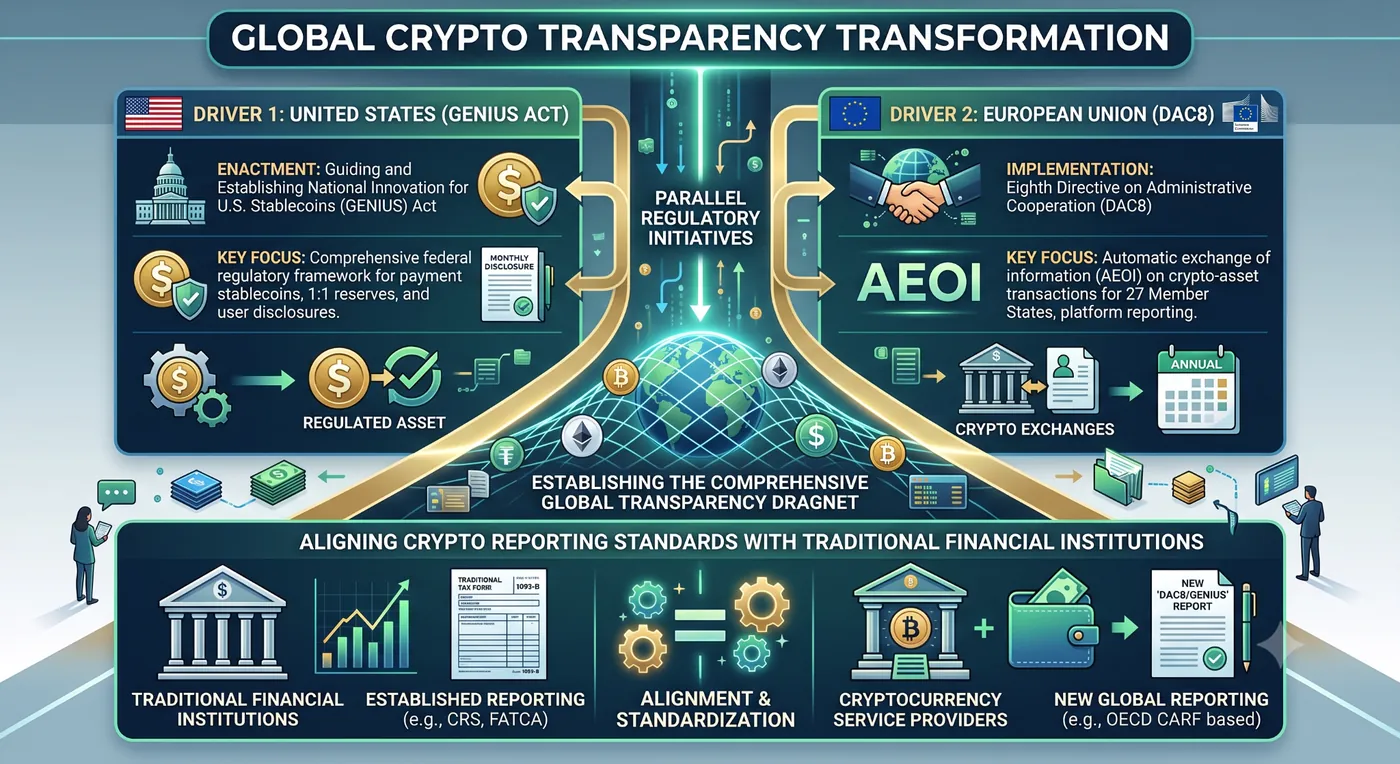
The legislation intentionally avoids modifying the Internal Revenue Code, and market participants face a significant divergence between streamlined regulatory oversight and an unchanged, high-friction tax framework. Under IRS Notice 2014-21, stablecoins remain treated as property rather than currency, requiring traders and corporations to account for every single on-chain swap and conversion.
The synchronization of the GENIUS Act in the United States and the DAC8 directive in the European Union represents a fundamental change in the digital asset regulatory landscape. The historical assumption of informational opacity is no longer a viable operational strategy. Digital asset transactions are now fully visible to tax authorities, requiring investors, platform operators, and tax advisors to establish robust compliance processes to mitigate risk and adapt to this highly transparent environment.
How Ondology Labs Can Help
As reserve attestations, cost-basis reconstruction, and Form 1099-DA reporting become table stakes, verifiable on-chain records matter more than ever. Ondology Labs provides blockchain auditing (proof of reserves, transaction reconciliation, and AML audits) alongside blockchain forensics and tracing that reconstruct transactional histories with court-ready evidence. For issuers, treasurers, and funds preparing for this transparent, mandatory-reporting era, that combination turns compliance from a liability into a competitive advantage.
Continue with Part 2: The DAC8 Directive and the EU's crypto tax transparency dragnet.
How Ondology Labs can help: Reserve claims only mean something when someone independent tests them. We provide proof of reserves audits and attestations covering both the assets held and the liabilities owed, statutory crypto audits with our ICPAC-licensed partner, and crypto audit support for engagements that already have an auditor.
Related reading: The DAC8 directive: the EU's crypto tax transparency dragnet · Crypto reporting obligations in Cyprus · DAC8 and CARF: a crypto tax guide for EU expats