The Institutional Stablecoin Avant-Garde: Banks and Fintechs Tokenize Fiat

By Iraklis Anastasiou · September 7, 2026
Since their emergence in 2014, stablecoins, which have surpassed $200 billion in circulation, have operated primarily as the liquidity lifeblood of crypto speculation, dominated by non-bank issuers operating on the fringes of the global banking system. However, as 2026 unfolds, a profound structural transformation is underway. Stablecoins have historically been structured to compose of fiat currency, commodity, or other cryptocurrencies. The era of non-bank monopoly over digital dollars and euros is drawing to a close. In its place, an institutional avant-garde, composed of Tier-1 global lenders, licensed fintech scale-ups, and century-old private banks, is stepping up to issue regulated, bank-grade stablecoins designed specifically for institutional treasury, cross-border settlement, and tokenized commercial payments.
The USD Megaconsortium: 21 Banks Eye 2027
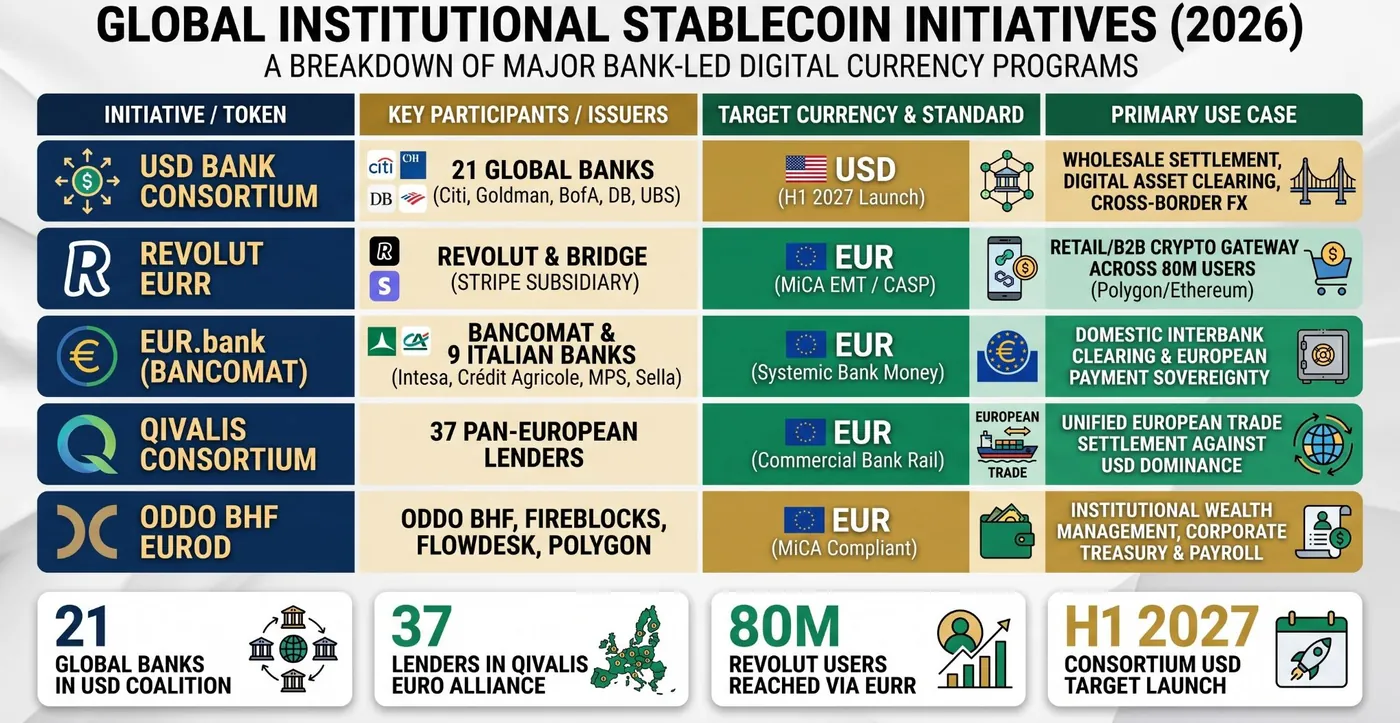
In a watershed development for global wholesale finance, twenty-one major international financial institutions committed on September 1, 2026, to establish a joint company during the second half of this year to issue a U.S. dollar-denominated stablecoin, targeting a commercial market launch in H1 2027. The heavy-hitting consortium brings together North American giants including Goldman Sachs, Citi, Bank of America, Wells Fargo, Fidelity Investments, Scotiabank, and TD Bank alongside major European institutions such as Deutsche Bank, UBS, Banco Santander, Crédit Agricole, Lloyds Banking Group, BBVA, and Commerzbank.
Drawing on bank-grade compliance, deep capital buffers, and institutional risk management, the unified dollar stablecoin aims to provide a trusted 24/7 settlement layer for wholesale interbank clearing, capital markets margin management, and cross-border corporate payments. By uniting 17 global systemically important banks (G-SIBs), the project seeks to displace fragmented private stablecoin rails with a single, highly liquid institutional standard.
Europe’s Euro Counteroffensive Under MiCA
While U.S. dollar tokens currently represent over 98% of total global stablecoin supply, Europe is mounting an aggressive, regulatory-backed counteroffensive powered by the Markets in Crypto-Assets (MiCA) framework. The EU’s legal clarity has given traditional financial institutions the regulatory confidence necessary to issue e-money tokens (EMTs) directly on public and permissioned blockchains.
Leading the fintech assault, London-based Revolut launched its first euro-backed stablecoin, EURR, on August 26, 2026. Issued by Luxembourg-based Bridge Building S.A., a subsidiary of Bridge, which was acquired by Stripe for $1.1 billion in early 2025, EURR is fully compliant with MiCA requirements and backed 1:1 by reserve assets. Initially rolled out to eligible customers in Denmark, Poland, and Portugal across Ethereum and Polygon networks, EURR connects Revolut's 80 million global users directly to on-chain finance, positioning the fintech giant to challenge dollar-denominated dominance in European digital trade.
Concurrently, traditional European banks are forming powerful regional alliances. In Italy, domestic payment leader Bancomat enlisted nine major banking partners, including Intesa Sanpaolo, Crédit Agricole Italia, Banca Generali, Monte dei Paschi di Siena (MPS), Banca Sella, and BPER, to launch "EUR.bank." Backed by the Italian Banking Association (ABI), EUR.bank acts as a systemic banking currency to modernize interbank settlements. On a broader scale, the Qivalis consortium has expanded to 37 pan-European lenders, pooling balance sheets to establish euro-denominated settlement rails as a direct counterweight to U.S. dollar stablecoin hegemony.
Private banking institutions are also moving fast. Franco-German wealth management titan ODDO BHF, a group with roots dating back to 1849, launched EUROD, one of the first MiCA-regulated euro stablecoins issued by a European bank. Built on Polygon Layer-2 with custody infrastructure supplied by Fireblocks and liquidity provided by market-maker Flowdesk, EUROD targets institutional asset management, automated corporate treasury, and B2B trade execution.
Emerging Market Treasury & Custody Evolution
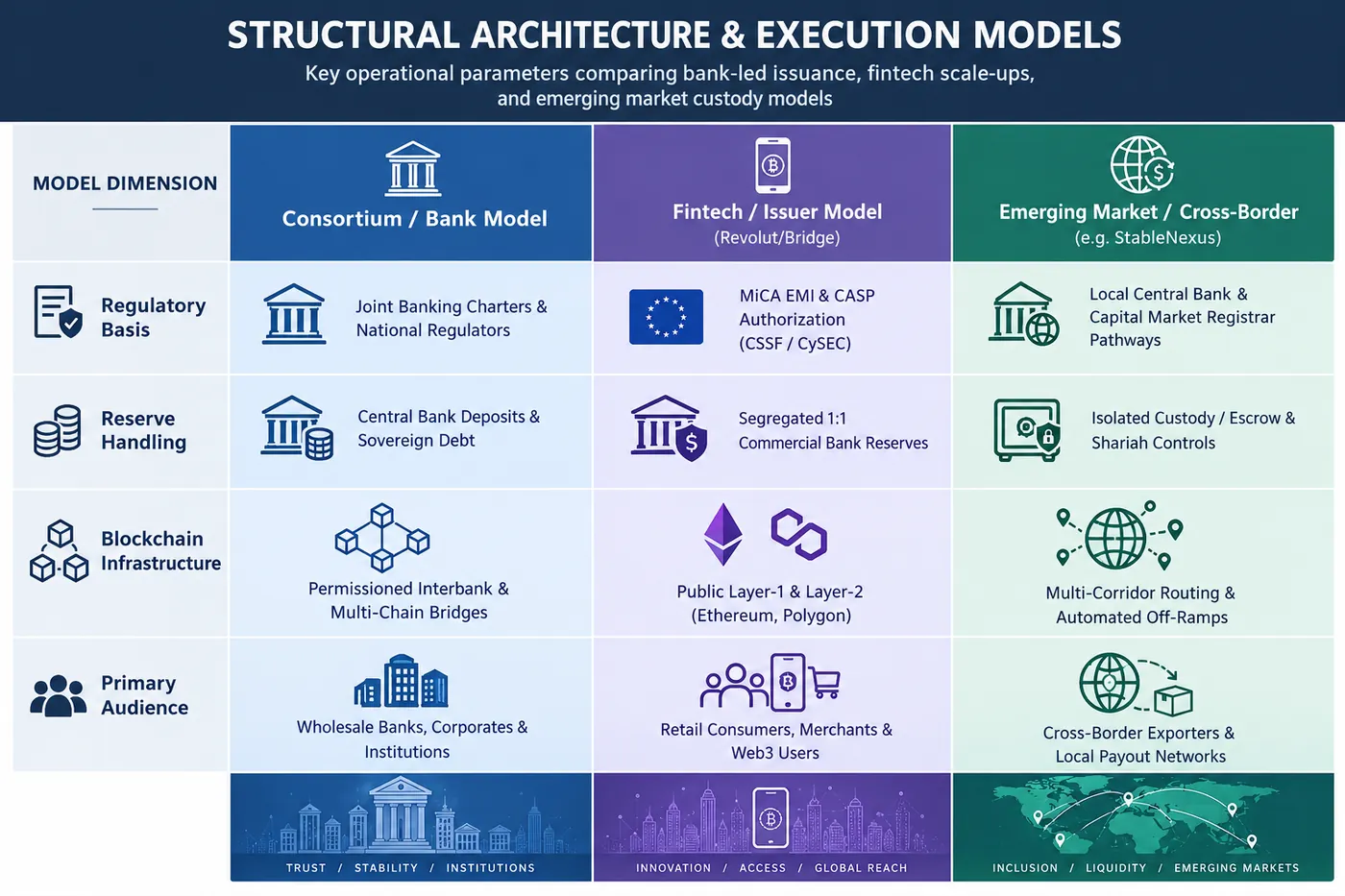
The institutional stablecoin revolution extends well beyond North America and Europe. In emerging markets across Southeast Asia and Latin America, corporate treasurers are increasingly replacing friction-laden SWIFT rails with regulated stablecoin corridors. The expansion of institutional digital fiat is equally pronounced across the Asia-Pacific (APAC) region, where sovereign regulators are creating formal registration pathways to integrate local fiat currencies onto distributed ledgers. A prime example of this regional evolution unfolded in Indonesia, Southeast Asia’s largest economy.
In mid-2026, Indonesia’s Financial Services Authority (Otoritas Jasa Keuangan or OJK) marked a milestone for institutional digital assets by formally graduating key stablecoin and custody models from its regulatory sandbox. OJK recorded PT Adhyoka Berkah Maju’s IDRP as an approved rupiah-stablecoin issuer framework. IDRP provides a compliant, rupiah-denominated digital settlement unit designed for corporate treasuries, local merchant settlement, and tokenized trade finance.
These emerging market frameworks establish strict production rollout models, requiring a clear separation between legal issuer obligations, segregated reserve custody, and named redemption executors. By establishing transparent, policy-enforced registration pathways and exportable audit proofs, institutional corridors allow multinational corporations to execute instant 24/7 cross-border FX settlements while adhering to local central bank guidelines.
As the competitive race between consortium dollars and regulated euro tokens intensifies, the fundamental nature of global liquidity is being rewritten. The convergence of strict regulatory frameworks like MiCA and DAC8 with the engineering prowess of enterprise custodians and blockchain networks has elevated stablecoins from speculative digital tokens to core financial infrastructure. For chief financial officers and institutional treasurers, the question is no longer whether to integrate stablecoin rails, but which regulated institutional standard will anchor their 24/7 global balance sheet.
How Ondology Labs can help: A bank-grade stablecoin stands or falls on the evidence behind its reserves and its licence. We run MiCA readiness reviews for issuers and CASPs preparing a CySEC file, deliver proof of reserves engagements that reconcile on-chain supply to segregated reserve assets, and provide crypto audit support to the audit firms and finance teams that have to sign off on tokenized fiat.
Related reading: MiCA authorisation in Cyprus: the complete guide · How to read a proof of reserves report · The GENIUS Act and the tax status of stablecoins.